
The hunting of helmeted hornbills is illegal in most of the species’ range countries (Jain et al., 2018), as it is shown to severely impact wild populations (Bennett et al., 1997; Johns, 2004).
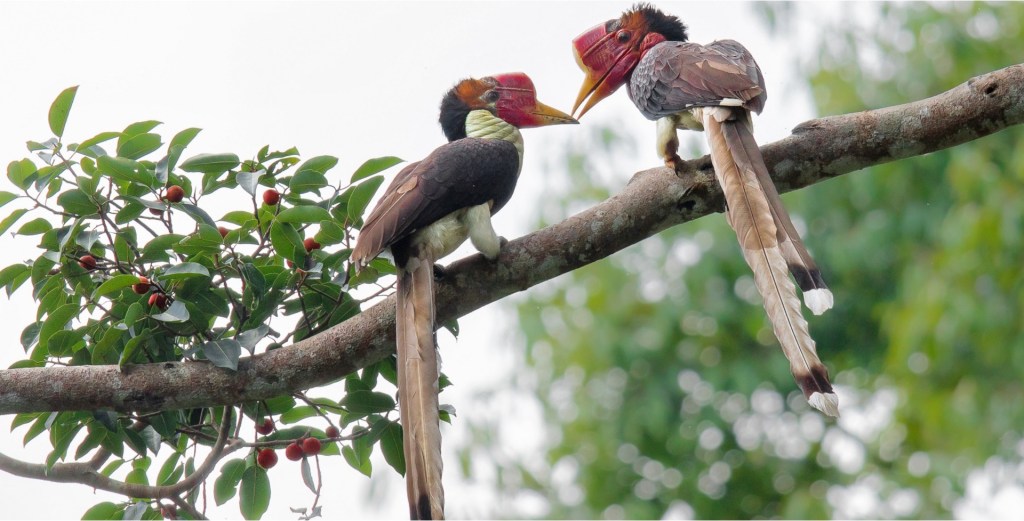
Credit: Jeeraphun Juntree/Alamy Stock Photo.
Not only do populations risk decline, but the removal of one sex of helmeted hornbill over another may greatly affect population dynamics, and therefore population recovery.
We developed a series of methods for identifying the sex of helmeted hornbills from their casques. Using visual analyses, genetics and morphometrics, we measured ~200 casques to determine any significant differences between males and females, which may provide a possible drive for poaching one sex > the other.
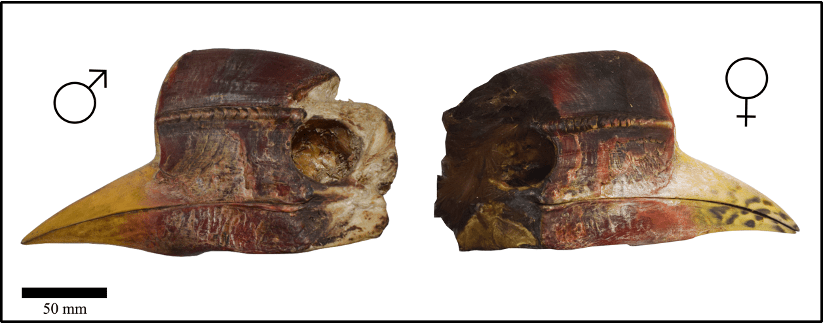
Our results show that both males and females were seized. Overall, more males were identified.
We also found juveniles present in the seizures.
Although male casques were significantly larger and heavier than females, the presence of both sexes, in both adults and juveniles, highlights no particular targeting of one sex or another.
This suggests that all individuals are threatened by this illegal trade.
As this is a critically endangered species, any demand presents a high risk for its survival. Alongside stringent enforcement to prevent the illegal trade, simultaneous efforts to conduct local community conservation and monitoring in “source” countries, and ensure that demand is minimal in “sink” countries, are key to prevent future threats to the species.
References:
Bennett, E. L., Nyao i, A. J. and Sompud, J. (1997). Hornbills Buceros spp. and culture in northern Borneo: can they continue to co-exist? Biological Conservation 82 (1): 41 – 46. https://doi.org/10.1016/S0006-3207(97)00012-8
Hatten, C. E. R., Tilley, H. B., Hadiprakarsa, Y., & Dingle, C. (2023). Three birds with one stone? Sex ratios of seized critically endangered helmeted hornbill casques reveal illegal hunting of males, females and juveniles. Animal Conservation, 26(4), 502-515. https://doi.org/10.1111/acv.12838
Jain A., Lee J. G. H., Chao N., Lees C., Orenstein R., Strange B. C., Chng S. C. L., Marthy W., Yeap C. A., Hadiprakarsa Y. Y. and Rao M. (Eds) (2018). Helmeted Hornbill (Rhinoplax vigil): Status Review, Range-wide Conservation Strategy and Action Plan (2018-2027). IUCN Species Survival Commission Hornbill Specialist Group.
Johns, A.G. (2004). Timber Production and Biodiversity Conservation in Tropical Rain Forests. UK: Cambridge University Press.
 Chloe Hatten