
Credit: C. Hatten
Auction markets are common places for selling ornamental wildlife products. However, it is difficult to know if products sold in these markets are illegal or legal (Gao & Clark, 2014, Gao et al., 2016, Chou, 2018).
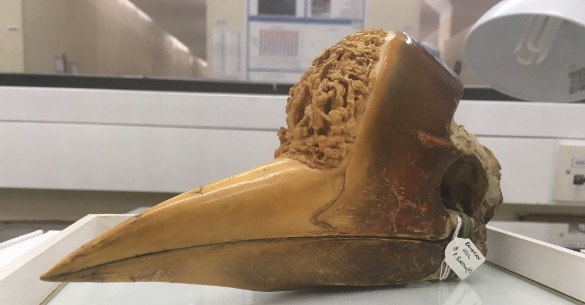
The helmeted hornbill (Rhinoplax vigil) bird, listed on the IUCN Red List of Threatened Species as ‘Critically Endangered’, is largely threatened by and the illegal wildlife trade for the bird’s casque – a protrusion above the beak which is carved into ornaments.
The tradition of carving helmeted hornbill casques dates back 1000s of years among local communities across Southeast Asia. The carved ornaments were often gifted as tributes to Emperors throughout the Ming and Qing Dynasties, and were valued ornaments in China and Japan (Yong, 2019).
However, the international trade in helmeted hornbill products is tightly regulated on Appendix I of CITES (the Convention on International Trade in Endangered Species of Wild Fauna and Flora), and this means that all commercial trade is banned.
One exception remains: products can be traded if they were purchased before the species was listed under CITES. These sorts of products are typically classed as “antiques”, which are common on art auctions. However, it is difficult to confirm the legality of origin/age. Therefore, on the scale of legal – illegal, these markets therefore represent a “grey” trade area.
Our project, published in Conservation Biology (Hatten et al., 2024), aimed to triangulate multiple data sources to understand the trade in helmeted hornbill casque products across the past 3 decades. We used three data sources: CITES (legal), seizures (illegal), and auctions (grey), comparing them to identify any patterns and correlations in trade and demand. We then discuss our methods and results in the wider context of wildlife trade, and discuss our findings of two potential markets for helmeted hornbill. Understanding the trade markets of endangered species is crucial before attempting to reduce demand.
Watch this 12 min video summary below, for more information.
Photo in video background: SANJITPAAL SINGH / JITSPICS.COM©
References:
Gao, Y., & Clark, S. G. (2014). Elephant ivory trade in China: Trends and drivers. Biological Conservation, 180, 23-30. https://doi.org/10.1016/j.biocon.2014.09.020.
Gao, Y., Stoner, K. J., Lee, A. T., & Clark, S. G. (2016). Rhino horn trade in China: An analysis of the art and antiques market. Biological Conservation, 201, 343-347. https://doi.org/10.1016/j.biocon.2016.08.001.
Hatten, C. E. R., Hadiprakarsa, Y. Y., Lam, J. Y., Mak, J., Toropov, P., & Dingle, C. (2024). Assessing the legal, illegal, and gray ornamental trade of the critically endangered helmeted hornbill. Conservation Biology, 38(5), e14358. https://doi.org/10.1111/cobi.14358.
Chou, H. W. (2018) China’s ivory auction market: A comprehensive analysis of legislation, historical data, and market survey results. TRAFFIC, Cambridge, UK. URL: https://www.traffic.org/site/assets/files/11150/chinas-ivory-auction-market.pdf.
Yong, D. L. (2019). The Ancient Wildlife Trade in Southeast Asia – From Zhao Rugua to Tome Pires. BirdLife International.
 Chloe Hatten