
Picture: mission-blue.org
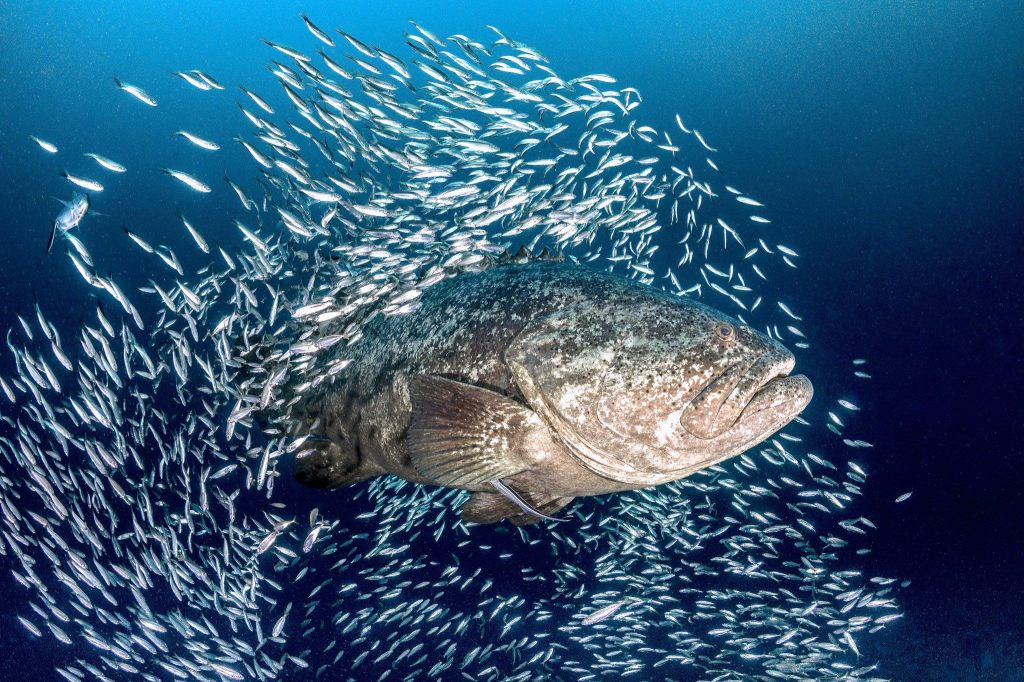
Groupers are long-lived, large-bodied fish living across many of the world’s oceans, and are important for many coral reef ecosystems.
In Fiji, groupers are important for local consumption and the local economy. As “Grade A” fish (high quality, high price), people are reliant on them for subsistence, local and international markets.
They are also fascinating animals, with some species forming “spawning aggregations”.
Spawning aggregations are phenomena whereby in some species (not just grouper), individuals will appear at a site at a particular time of the year/month (e.g. a full moon) and release their gametes all at once. These spectacular mass aggregations draw keen spectators and divers to capture the rapid event (and even made it onto Blue Planet II). They also attract other predatory animals, like sharks, who take advantage of the large numbers of fish in a small area.
However, spawning aggregations also make easy, predictable targets for fishers. Unless protected during these spawning seasons, populations of these spectacular species could be wiped out.
Our work published in Journal of Fish Biology integrates data from multiple sources across two decades (2002-2022), including fisher interviews, market surveys, stock assessments, and underwater census to assess the status of the country’s grouper fishery. We show catch rates are declining and trade includes a high percentage of immature groupers, particularly for aggregating species. We suggest management for groupers should seek to (1) improve spatial and temporal protection of spawning aggregations and (2) increase minimum-size restrictions for capture and sale.
Ultimately, we highlight that conservation management should seek to integrate local knowledge and science to improve the status for human livelihoods and species threatened by human consumption alike.
 Chloe Hatten